

Data Communication Networking
Data Communication takes place between two devices that are directly connected
by some form of point-to-point transmission medium. The devices are very far
apart. It would be inordinately expensive if string a dedicated link between two
devices which is thousands of miles apart. There is set of devices used to
establish such networks. There are following types of networking available:
Wide Area Network (WAN)
Wide area networks have traditionally been considered to be those that cover a
large geographical area. Typically, a WAN consists of a number of interconnected
switching nodes. Transmission from any one device is routed through these
internal nodes to the specific destination device. WAN has been implemented
using one of the following technologies:
Circuit Switching
In circuit-switching, this path is decided upon before the data transmission
starts. The system decides on which route to follow, based on a
resource-optimizing algorithm, and transmission goes according to the path. For
the whole length of the communication session between the two communicating
bodies, the route is dedicated and exclusive, and released only when the session
terminates.
Packet Switching
In packet-switching, the packets are sent towards the destination irrespective
of each other. Each packet has to find its own route to the destination. There
is no predetermined path; the decision as to which node to hop to in the next
step is taken only when a node is reached. Each packet finds its way using the
information it carries, such as the source and destination IP addresses.
Frame Relay
Frame relay was developed to take advantage of these high data rates and low
error rates. Whereas the original packet switching networks were designed with a
data rate to the end user of about 64kbps, frame relay networks are designed to
operate efficiently at user data rates of up to 2Mbps.
ATM
Asynchronous Transfer Mode (ATM) can be viewed as an evolution from frame relay.
The most obvious difference between frame relay and ATM is that frame relay uses
variable-length packets, called frames, and ATM uses fixed-length packets,
called cells. As with frame relay, ATM provides little overhead for error
control, depending on the inherent reliability of the transmission system and on
higher layers of logic in the end systems to catch and correct errors. By using
a fixed packet length, the processing overhead is reduced ever further for ATM
compared to frame relay. The result is that ATM is designed to work in the range
of 10s and 100s of Mbps, compared to the 2Mbps target of frame relay.
Local Area Network (LAN)
LAN is a communication network that interconnects a variety of devices and
provides a means for information exchanged among those devises. The scope of the
LAN is small, typically a single building or a cluster of buildings. It is
usually the case that the LAN is owned by the same organization that owns the
attached devices. The internal data transfer rates of the LANs are greater than
WANs. There are various topologies are possible like Bus, Right etc.
Ethernet
In Bus topology, at any instance one machine is the master and is allowed to
transmit. An arbitration mechanism is needed to resolve conflicts when two or
more machine wants to transmit simultaneously. The arbitration mechanism may be
centralized or distributed. IEEE 802.3 CSMA/CD popularly known as Ethernet, is a
bus based broadcast network with decentralized control operating at 10 or 100
Mbps. Computers on an Ethernet can transmit whenever they want to. If two or
more packets collide, each computer just waits a random time and tries again
later to send.
Token Ring
Unlike Ethernet, Token Ring uses a ring topology whereby the data is sent from
one machine to the next and so on around the ring until it ends up back where it
started. It also uses a token passing protocol which means that a machine can
only use the network when it has control of the Token; this ensures that there
are no collisions because only one machine can use the network at any given
time.
ISDN and Broadband ISDN
Through Integrated Service Digital Network (ISDN) user with a single access
point to ISDN network can avail of different kinds of communication like his
computer can access the internet, he can use the network for his telephone
usages and also probably video communication. The ISDN is intended to be a
worldwide public telecommunications network to replace existing public
telecommunications networks and deliver a wide variety of services.
The second generation referred to as Broadband ISDN, supports vary high data
rates (100s of Mbps) and has a packet switching oriented.
Protocols and Protocol Architecture
To transfer any file or say data between two or more computers there must be a
path either directly or any communication network known as computer
communication. Similarly when two or more computers are interconnected via a
communication network referred as computer network. Computer communication and
computer network has some protocols and communication architecture.
A protocol is set of rules for communicating between computers. Protocol
includes the key like data format, timings, sequencing, error controls etc.
Without these rules, the computer can not make sense of the stream of incoming
bits.
Basically, protocol is software that resides either in a computer's memory or in
the memory of a transmission device, like network interface card. When data is
ready for transmission, this software is executed.
Two protocol architectures have served as the basis for the development of
interoperable communications standards: the TCP/IP protocol suite and the OSI
reference model. TCP/IP is the most widely used interoperable architecture, and
OSI has become the standard model for classifying communication functions. Here
is the brief introduction of them.
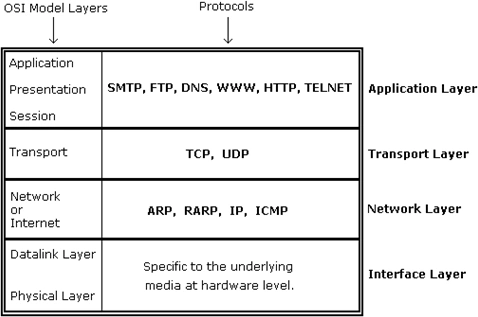
The OSI Protocol Architecture
Open System Interconnection (OSI) includes set of protocols that attempt to
define and standardize the data communication process defined by International
Standardization for Organizations. The OSI model has seven layers as discussed
below.
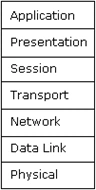
- Physical Layer
Physical Layer deals with the hardware level like, transmission media, connections and the voltage for digital signals. In other word physical layer provides the electrical and mechanical interface to the network medium (cables). - Data Link Layer
Data Link Layer deals with physical transfer, framing (the assembly of data bits into single unit), flow control and error control functions. It is responsible for getting the data packaged for the physical layer. Data Link layer subdivided into two parts LLC (Logical Link Control) and MAC (Medium Access Control).
- Network Layer
Network Layer is very important layer in OSI Protocol Architecture. Network layer deals with the transfer of data in the form of packets over the communication networks. A key aspect of this transfer is the routing of packets from the source to destination machine. Routing is the process by which a path is selected out of many available paths to the destination so that data packets reach the destination fast, efficiently, reliably as required. Network layer is also responsible for translating logical address or names into physical (or data link) addresses.
- Transport Layer
Transport Layer ensures that data is successfully sent and received between two end nodes. If data is sent incorrectly, this layer has the responsibility to ask for re-transmission of the data. Also it ensures data are passes onto the upper layers in the same order in which they where sent. Specially, it provides a reliable, network-independent message interchange service to the top three application oriented layers.
- Session Layer
Session Layers decides when to turn communication on or off between two computers. It also deals with the programs running in each machine to establish conversations between them.
- Presentation Layer
Presentation Layer performs code conversation and data re-formatting (translating). It is translator of the network, making sure the data is in the correct form for the receiving application.
- Application Layer
This layer provides the interface between the software running in a computer and the network. It provides functions to the user's software, including file transfer access and management and electronic mail services.
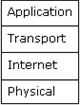
TCP/IP has no any official protocol model as there is in case of ISI model. OSI model where defined by International Standardization for Organizations (ISO). But in case TCP/IP, has no any such. However, based on protocol standards TCP/IP have been developed and it has five layers.
-
Physical Layer
Physical Layer covers the interface between a data transmission device (computer) and a transmission medium or network. - Network Layer
This layer covers the exchange of data between end systems and the network to which it is attached. The transmitter computer provide the network path and destination address.
- Internet Layer
Internet Protocol is used by this layer to provide the routing function across multiple networks.
- Transport Layer
This layer ensures that data is sent and received successfully or not. If any error occurred then it sends the re-transmission request.
- Application Layer
It provides user friendly interface between user and transmission devices. For example, file transfer, electronic mail services etc.
Paul SimpsonPosted Sep 20, 2010, 8:57 PM
Interesting article (although I had hoped it was going to be about how to use c# to establish network comms.) Only point revolves arounf TCP and UDP. I think you will find that UDP is at the transport layer, but TCP is at the session (one of the differences between them) Your statement about the transport layer ensuring "that data is sent and received successfully or not. If any error occurred then it sends the re-transmission request" is also wrong. That's session layer ;-) Hence TCP is connection-orientated (reliable) whereas UDP is connectionless (fire-and-forget).