

Introduction
Rust, which is known for focusing on safety, performance, and zero-cost abstractions, expands into the field of metaprogramming with the help of a feature set called Macros. We will cover all the details you need to know about Macros in Rust, including their definition, syntax, applications, and unmatched benefits.
What is Macros in Rust?
The powerful feature of the Rust programming language that makes metaprogramming easier is called macros, which is an acronym for "macro_rules".Unlike regular functions or procedures, macros operate during the compile-time phase, enabling the generation of code based on predefined patterns. Rust's expressiveness is increased by this feature, which gives programmers the ability to write reusable and adaptable code structures.
Metaprogramming
Metaprogramming refers to writing code that writes or modifies other code. Macroprogramming in Rust provides access to this metaprogramming model. They enable developers to specify rules and patterns that, when matched, produce code snippets.
Roles in Code Generation
In code generation, macros are important because they let developers reduce boilerplate code, abstract away repetitive tasks, and build domain-specific languages (DSLs) that are specific to problem domains. Rust programmers can communicate complicated ideas clearly and understandably due to this metaprogramming capability.
Syntax
In Rust, macros are defined by using the "macro_rules!" keyword, which is followed by the macro's name and the pattern that needs to match. When the macro is expanded into the desired code by the compiler, it follows a set of rules similar to the syntax. These guidelines specify how the generated code is changed from the macro's invocation.
// macro definition
macro_rules! greet {
    ($name:expr) => {
        println!("Hello, {}!", $name);
    };
}

// Invoking the macro
fn main() {
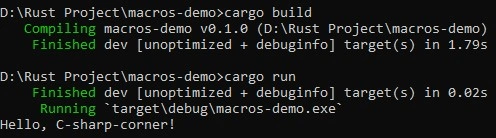
    greet!("C-sharp-corner");
}
In this code, the 'greet' macro takes an expression ('$name') and generates code that prints a greeting with the provided name. The 'macro_rules!' keyword introduces the macro definition, and the pattern '($name:expr)' captures the expression passed to the macro.
Output
Types of Macros
There are two types of macros in Rust.
Declarative Macros
Declarative macros, often referred to as "macros by example" or "macro_rules! macros," are a foundational aspect of Rust's metaprogramming capabilities. They resemble function calls and operate on patterns defined by the developer.
Syntax
macro_rules! declarative_macro {
    // Pattern matching and replacement rules
    ($arg:expr) => {
        // Code to be generated when the macro is invoked
        println!("Value: {}", $arg);
    };
}
Use Cases
- Code Repetition: Declarative macros work best when a certain structure or pattern is used repeatedly across the codebase. Developers can avoid redundancy and enhance maintainability by encapsulating this pattern within a macro.
Rust
 declarative_macro!(42);
 declarative_macro!("Hello, Declarative Macros!");
- Abstraction: They provide a means of abstraction by allowing developers to create custom, higher-level constructs that expand into lower-level code. This is particularly useful for creating DSLs or enhancing the expressiveness of the language.
OutputRust
// Define a macro for creating a vector with a specified type
macro_rules! typed_vector {
    ($elem_type:ty; $($value:expr),*) => {
        {
            let mut v = Vec::<$elem_type>::new();
            $(v.push($value);)*
            v
        }
    };
}

fn main() {
    // Use the macro to create a vector of u32
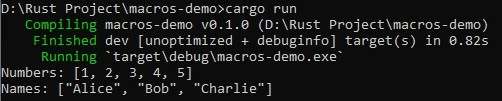
    let numbers: Vec<u32> = typed_vector!(u32; 1, 2, 3, 4, 5);

    // Use the macro to create a vector of strings
    let names: Vec<&str> = typed_vector!(&str; "Alice", "Bob", "Charlie");

    // Print the vectors
    println!("Numbers: {:?}", numbers);
    println!("Names: {:?}", names);
}
Procedural Macros
Rust metaprogramming is pushed to a new level by procedural macros. They work on the Rust code's Abstract Syntax Tree (AST), as compared to declarative macros, which enables more complex code generation and transformations. Because procedural macros are so strong and adaptable, programmers can create unique syntax extensions and perform complex manipulations during compilation.
Example
use proc_macro;

// A procedural macro that transforms a function into a unit test
#[proc_macro]
pub fn my_procedural_macro(input: proc_macro::TokenStream) -> proc_macro::TokenStream {
    // Custom logic to manipulate the AST and generate code
    let expanded = quote::quote! {
        #[test]
        fn my_generated_test() {
            // Original function body goes here
            #input
        }
    };
    expanded.into()
}
Use Cases
- Custom Derive Macros: Custom derive macros are often executed using procedural macros, which allow developers to automatically create trait method implementations based on a data type's structure.
Rust
// Custom derive macro for a simple trait #[derive(MyCustomTrait)] struct MyStruct; - Domain-Specific Languages (DSLs) - Rust procedural macros allow programmers to write domain-specific languages. This can provide a syntax that is specific to particular problem domains, which can result in more expressive and readable code.
Let's create a simple DSL for defining a list of people with their attributes.
macro_rules! people_list {
    ( $($name:ident { $($attr:ident : $val:expr),* }),* ) => {
        {
            let mut people = Vec::new();

            $(
                let person = Person {
                    name: stringify!($name).to_string(),
                    $($attr: $val),*
                };
                people.push(person);
            )*

            people
        }
    };
}

// Example struct
#[derive(Debug)]
struct Person {
    name: String,
    age: u32,
    city: String,
}

// Using the People List DSL macro
fn main() {
    let people = people_list! {
        Alice { age: 30, city: "New York".to_string() },
        Bob { age: 25, city: "San Francisco".to_string() },
        Carol { age: 35, city: "Seattle".to_string() }
    };

    for person in people {
        println!("{:?}", person);
    }
}
Output

Advanced Macro Features
Let's explore the advanced features of the macro.
Macro Hygiene
One of the distinctive features of Rust macros is the concept of macro hygiene, a mechanism designed to ensure the safety and predictability of generated code. Macro hygiene prevents unintended variable captures and naming conflicts that could arise when macros are expanded within different contexts. When a macro is expanded, it may introduce variables or identifiers into the code. Without proper hygiene, these identifiers could clash with existing variables in the calling scope, leading to unexpected behavior or errors.
Example
Without macro hygiene
macro_rules! unsafe_macro {
    ($x:expr) => {
        let y = 42; // introduces a variable 'y'
        $x + y // potential unintended capture
    };
}

fn main() {
    let y = 10;
    println!("{}", unsafe_macro!(y)); // Could lead to unexpected behavior
}
Applying macro hygiene
macro_rules! safe_macro {
    ($x:expr) => {{
        {
            let __hygiene_y = 42; // introduces a hygiene-scoped variable '__hygiene_y'
            $x + __hygiene_y // ensures no unintended capture
        }
    }};
}

fn main() {
    let y = 10;
    println!("{}", safe_macro!(y)); // No unintended capture due to macro hygiene
}
In the example above, the use of '__hygiene_y' within the macro ensures that the introduced variable does not unintentionally clash with variables in the calling scope, providing a level of safety and predictability.
Variable-Length Argument Lists
Macros in Rust are not limited to a fixed number of arguments. They can handle variable-length argument lists, providing flexibility in usage. This feature allows developers to create macros that adapt to different scenarios, accepting a variable number of arguments.
Example
macro_rules! print_values {
    // Base case: no more values to print
    () => {};

    // Recursive case: print the current value and call the macro again for the rest
    ($value:expr $(, $rest:expr)*) => {
        println!("{}", $value);
        print_values!($($rest),*);
    };
}

fn main() {
    print_values!(1, 2, 3, "hello", true);
}
In this example, the 'print_values' macro accepts various arguments and prints each one. The use of '$(, $rest:expr)*' allows the macro to handle any number of arguments separated by commas.
Best Practices and Considerations
Let's explore the best practices.
Code Readability
Working with macros requires maintaining the readability of the code because they can introduce abstraction and complexity. Here are some tips to ensure clear and concise macro implementations without compromising code readability.
- Meaningful Naming: Choose descriptive and meaningful names for your macros. A well-named macro helps convey its purpose and usage, making the code more understandable for others (and future you).
Rust
macro_rules! create_person_struct { // ... } - Use Consistent Formatting: Adopt a consistent and visually appealing formatting style for your macros. Consistency in indentation, line breaks, and other formatting choices contributes to a cleaner and more readable codebase.
Rust
macro_rules! html_element { // ... } - Commenting and Documentation: Include comments and documentation to explain the purpose and usage of the macro. Clear comments help readers understand the macro's role and prevent misunderstandings.
Rust
/// Macro for creating HTML elements with specified attributes and content. macro_rules! html_element { // ... } - Modularization: If a macro becomes too complex or involves multiple functionalities, consider breaking it into smaller, modular macros. This promotes better organization and allows developers to grasp individual components more easily.
Rust
// Modular macros for HTML generation
    macro_rules! open_tag {
        // ...
    }

    macro_rules! close_tag {
        // ...
    }
Error Handling in Macros
One of the most important aspects of writing reliable code is handling errors within macros. While Rust's macro system does not support traditional error handling methods of using {Result} or `?}, there are still approaches that can be taken to manage errors effectively.
- Informative Error Messages - Write error messages that provide meaningful information about what went wrong. This helps developers quickly identify and address issues during compilation.
Rust
macro_rules! validate_input { ($input:expr) => { if !is_valid($input) { compile_error!("Invalid input. Please check the provided value."); } }; } - Use 'unreachable!' for Unhandled Cases - In situations where a certain case should never occur, use 'unreachable!()' to signal that the compiler should consider it unreachable. This ensures that unexpected scenarios are caught during compilation.
Rust
macro_rules! process_data { (valid_case) => { // Handle valid case }; // Handle any unexpected case with an informative error message ($unexpected:tt) => { compile_error!("Unexpected case: {:?}", stringify!($unexpected)); unreachable!(); }; } - Macro-Specific Debugging Information - Introduce debugging information within the macro to assist developers in understanding the context of an error. This can include printing relevant values or using 'stringify!' to display macro input.
Rust
macro_rules! debug_info {
        ($value:expr) => {
            println!("Debugging information: {}", $value);
        };
    }
Testing and Iterative Development
Test your macros thoroughly and iterate on them. This helps catch potential issues early in the development process and ensures that error-handling mechanisms are effective.
    #[test]
    fn test_validate_input_macro() {
        // Test valid input
        validate_input!(42);

        // Test invalid input
        // (compile_error!() will be triggered, indicating an error in the macro)
        // validate_input!("invalid");
    }
Conclusion
Rust's macros enable powerful code generation and manipulation during compile time. They come in two types, declarative macros for reducing repetition and providing abstraction, and procedural macros for advanced transformations. Macro hygiene ensures code safety, and variable-length argument lists add flexibility. Best practices include clear naming, consistent formatting, and effective error handling. Rust's macro system empowers developers but requires careful adherence to maintain readability and reliability.
Join the conversation! Your thoughts help the community grow.