

This article explains method overriding and its various applications using examples in C#.
Method Overriding
Overriding can be defined as: being able to change or augment the behavior of methods in classes, known as overriding their logic; it is one of the most powerful aspects of Object Oriented Programming.
Explanation
Suppose you have a Phone, no please don’t suppose everyone has a phone today, although some people even have more than one. Okay leave it, so if you have phone:

Then there must be ring facility in it:
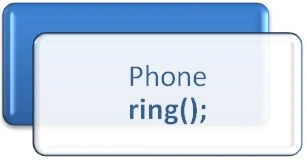
Now your phone can be of any type, like it can be cellular, satellite or landline, these all types of phones will also have the same or a different functionality (based on their attribute).
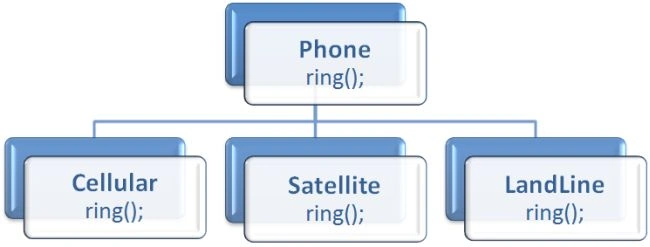
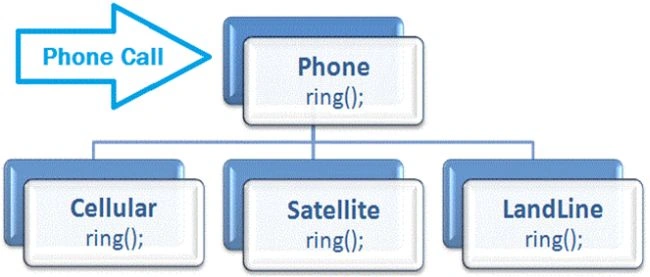
Now whenever you receive a call, the caller doesn’t know whether you have a cellular phone, landline phone or anything else, he/she just calls you and according to that call operation your phone rings. In the case of method overriding, your phone works as a class and the ring is the functionality.
Keywords in Method Overriding
There are the following 3 types of keywords used in C# for method overriding:

Virtual Keyword
It tells the compiler that this method can be overridden by derived classes.
public virtual int myValue()
{
    -
    -
    -
}
Override Keyword
In the subclass, it tells the compiler that this method is overriding the same named method in the base class.
public override int myValue()
{
     -
     -
     -
}
Base Keyword
In the subclass, it calls the base class method for overriding functionality.
base.myValue();Method Overriding Example
using System;
using System.Collections.Generic;
using System.Linq;
using System.Text;
namespace Hello_Word
{
    class baseClass
    {
        public virtual void Greetings()
        {
            Console.WriteLine("baseClass Saying Hello!");
        }
    }
    class subClass : baseClass
    {
        public override void Greetings()
        {
            base.Greetings();
            Console.WriteLine("subClass Saying Hello!");
        }
    }
    class Program
    {
        static void Main(string[] args)
        {
            baseClass obj1 = new subClass();
            obj1.Greetings();
            Console.ReadLine();
        }
    }
}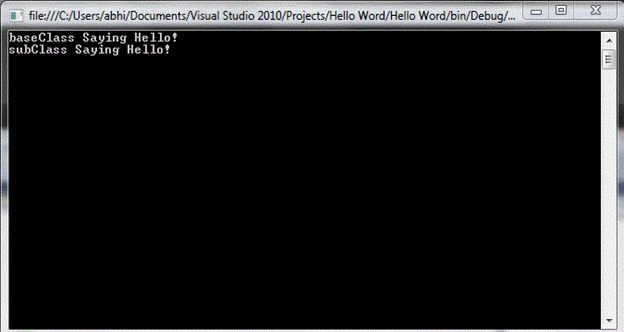
An output window is showing that baseClass will get called first and then subclass. If we make certain changes in this code like:
base.Greetings();
Console.WriteLine("subClass Saying Hello!"); // current scenario
After making a few modifications as in the following:
Console.WriteLine("subClass Saying Hello!");
base.Greetings(); // after modifications
Now our output will be like this:
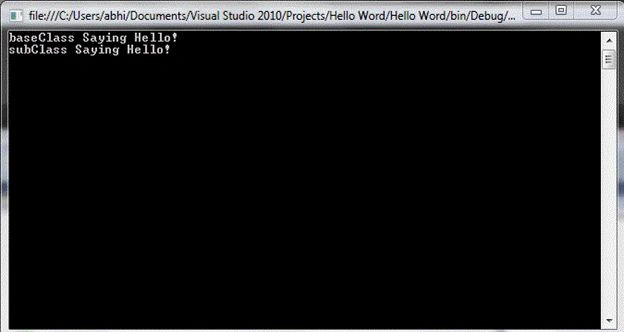
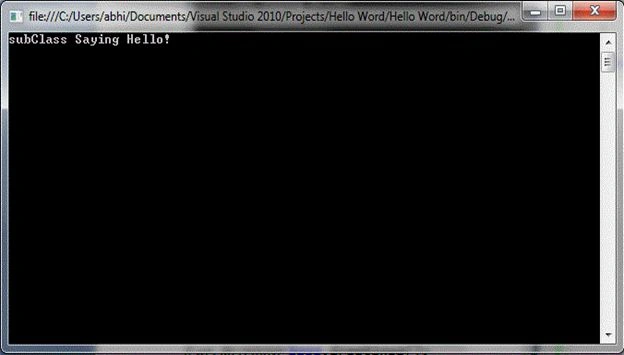
If we remove "base.Greetings();" then the compiler will not call the baseclass as in the following:
using System;
using System.Collections.Generic;
using System.Linq;
using System.Text;
namespace Hello_Word
{
    class baseClass
    {
        public virtual void Greetings()
        {
            Console.WriteLine("baseClass Saying Hello!");
        }
    }
    class subClass : baseClass
    {
        public override void Greetings()
        {
            Console.WriteLine("subClass Saying Hello!");
            // base.Greetings();
        }
    }
    class Program
    {
        static void Main(string[] args)
        {
            baseClass obj1 = new subClass();
            obj1.Greetings();
            Console.ReadLine();
        }
    }
}
Now making some other changes, like placing:
baseClass obj1 = new baseClass();
obj1.Greetings();
Instead of:
baseClass obj1 = new subClass();
obj1.Greetings();
Now let’s check the output window, what’s its showing now:
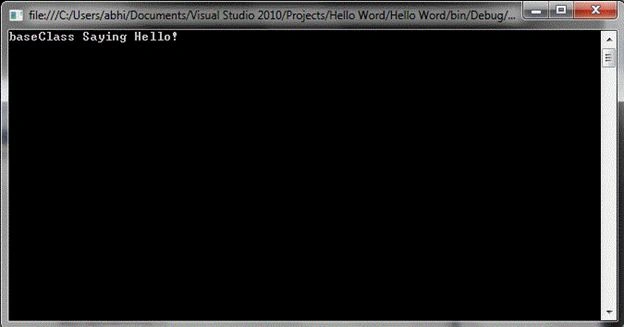
So as you are seeing that now its calling only the baseClass. So now I guess you will be a little closer to the method overriding functionality.
Tomasz BorawskiPosted Jul 6, 2023, 8:43 PM
You should also explain hiding (new keyword)
Dhara BhatiaPosted Jun 30, 2017, 6:57 AM
Have a small doubt..how `Console.WriteLine("subClass Saying Hello!"); base.Greetings(); // after modifications` will print `baseclass saying hello subclass saying hello`..doesn't it print first `subclass saying hello`?
Manish KumarPosted Apr 1, 2017, 3:39 AM
Thank you Abhishek for the tutorial. You have posted wrong screen-shot for the function Console.WriteLine("subClass Saying Hello!"); base.Greetings(); // after modifications Please modify it as it will create more confusion for the reader. One more request to you please verify the article before posting as it reaches to many readers. Thank you once again. Regards, Manish