

Introduction
In this article we will learn about what is lru cache and how we can implement it in python. LRU derrived as Least Recently Used cache. LRU is an powerful data structure its use for maintains a limited set of items while automatically removing the least recently accessed ones. Its perfevtly use forscenarios where you want to keep frequently accessed data readily available.
Implementation of LRU( Least Recently Used ) cache
1. Node Class
Python
class Node:
    def __init__(self, key, value):
        self.key = key
        self.value = value
        self.prev = None
        self.next = None
This defines a Node for our doubly linked list.
- Stores a key-value pair
- Has references to previous and next nodes
- These connections allow us to quickly remove and reposition nodes
2. LRUCache Initialization
Python
def __init__(self, capacity):
    self.capacity = capacity
    self.cache = {}

    # Create dummy head and tail nodes for initialization
    self.head = Node(0, 0)
    self.tail = Node(0, 0)
    self.head.next = self.tail
self.tail.prev = self.head- Sets the maximum capacity of the cache
- Creates an empty dictionary to map keys to nodes for O(1) search
- Creates dummy head and tail nodes
- Links these dummy nodes together to form an empty list structure
3. Node Management Methods
Add Node
Python
def _add_node(self, node):
    # Add node data right after head
    node.prev = self.head
    node.next = self.head.next
    self.head.next.prev = node
self.head.next = node- Adds a new node right after the head (most recently used position)
- Updates connections in a specific order to avoid breaking the list
Remove Node
Python
def _remove_node(self, node):
    # Remove an existing node from the linked list
    prev = node.prev
    new = node.next
    prev.next = new
new.prev = prev- Removes a node by updating the connections of its neighbors
- The node itself becomes disconnected from the list
Move Node
Python
def _move_to_head(self, node):
    # Move certain node to the head
    self._remove_node(node)
self._add_node(node)- Combines removal and addition to move an existing node to the head
- Used when an item is accessed to mark it as most recently used
Python
def _pop_tail(self):
    # Pop the last node
    res = self.tail.prev
    self._remove_node(res)
return res- Removes and returns the node right before the tail (least recently used)
- Used when we need to evict an item to make room
4. Cache Operations
Python
def get(self, key):
    node = self.cache.get(key, None)
    if not node:
        return -1

    # Move the accessed node to head
    self._move_to_head(node)
return node.value- Looks up the key in our dictionary in O(1) time
- If found, moves the node to the head (marks as recently used), which is the most important part of the algorithm
- Returns the value or -1 if not found
Python
def put(self, key, value):
    node = self.cache.get(key)

    if not node:
        newNode = Node(key, value)
        self.cache[key] = newNode
        self._add_node(newNode)

        if len(self.cache) > self.capacity:
            # Pop the tail
            tail = self._pop_tail()
            del self.cache[tail.key]
    else:
        # Update the value
        node.value = value
self._move_to_head(node)- If the key exists, updates its value and moves it to the head
- If the key is new:
- Creates a new node
- Adds it to the dictionary
- Adds it to the front of the list
- If over capacity, remove the least recently used item (from the tail)
- Also removes this evicted item from the dictionary
Combine Example of LRU cache
Python
class Node:
    def __init__(self, key, value):
        self.key = key
        self.value = value
        self.prev = None
        self.next = None


class LRUCache:
    def __init__(self, capacity):
        self.capacity = capacity
        self.cache = {}

        # Create dummy data head and tail nodes
        self.head = Node(0, 0)
        self.tail = Node(0, 0)
        self.head.next = self.tail
        self.tail.prev = self.head

    def _add_node(self, node):
        # Add node right after head
        node.prev = self.head
        node.next = self.head.next

        self.head.next.prev = node
        self.head.next = node

    def _remove_node(self, node):
        # Remove an existing node from the linked list
        prev = node.prev
        new = node.next

        prev.next = new
        new.prev = prev

    def _move_to_head(self, node):
        # Move certain node to the head
        self._remove_node(node)
        self._add_node(node)

    def _pop_tail(self):
        # Pop the last node
        res = self.tail.prev
        self._remove_node(res)
        return res

    def get(self, key):
        node = self.cache.get(key, None)
        if not node:
            return -1

        # Move the accessed node to head
        self._move_to_head(node)
        return node.value

    def put(self, key, value):
        node = self.cache.get(key)

        if not node:
            newNode = Node(key, value)
            self.cache[key] = newNode
            self._add_node(newNode)

            if len(self.cache) > self.capacity:
                # Pop the tail
                tail = self._pop_tail()
                del self.cache[tail.key]
        else:
            # Update the value
            node.value = value
            self._move_to_head(node)


# Create a cache with capacity of 2
cache = LRUCache(2)

cache.put(1, 1)           # Cache: {1=1}
cache.put(2, 2)           # Cache: {1=1, 2=2}
print(cache.get(1))       # Returns 1, Cache: {2=2, 1=1}
cache.put(3, 3)           # Removes key 2, Cache: {1=1, 3=3}
print(cache.get(2))       # Returns -1 (not found)
cache.put(4, 4)           # Removes key 1, Cache: {3=3, 4=4}
print(cache.get(1))       # Returns -1 (not found)
print(cache.get(3))       # Returns 3, Cache: {4=4, 3=3}
print(cache.get(4))       # Returns 4, Cache: {3=3, 4=4}
Output
Bash
1
-1
-1
3
4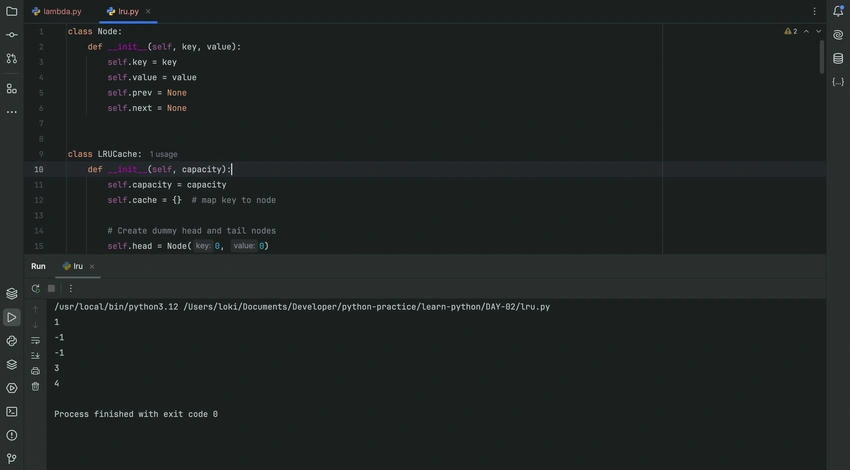
Uses of LRU Cache
- Database query caching
- Web server response caching
- Browser history management
Summary
By implementing an LRU cache, you can significantly improve the performance of applications that repeatedly access expensive-to-compute data
Join the conversation! Your thoughts help the community grow.