

Introduction
The internet has connected billions of people, but most digital platforms still operate on an outdated model: users contribute value while platforms capture the majority of the benefit.
Developers write tutorials, answer questions, mentor others, build projects, and help communities grow — yet most of these contributions are rewarded with little more than views, likes, or temporary visibility.
At the same time, AI is transforming how people learn and build.
In this new AI-native world, traditional signals like resumes and degrees are becoming less meaningful on their own. What matters increasingly is:
What you contribute
What you learn
What you build
How consistently you participate
But there is still a major gap.
There is no unified system that can:
Track contributions
Validate skills
Reward participation
Build portable reputation
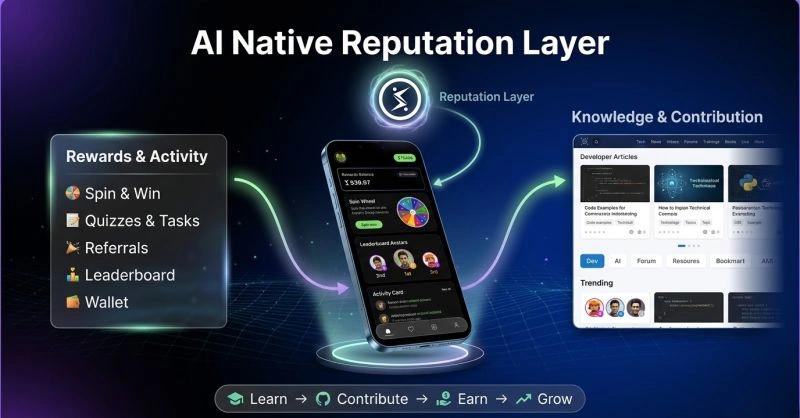
This is where the idea of an AI Native Reputation Layer becomes important.
The Problem With Traditional Systems
Most systems used to evaluate talent today were designed for a different era.
Resumes are static
Degrees are limited snapshots in time
Certifications often fail to represent continuous growth
Meanwhile, modern digital communities depend heavily on active contributors:
Developers
Writers
Mentors
Builders
Community leaders
Yet contributors rarely receive long-term ownership or meaningful incentives for their participation.
This creates a broken engagement cycle:
Communities struggle to sustain participation
Contributors feel undervalued
Valuable knowledge becomes fragmented
The future requires a different model — one where contribution itself becomes measurable and rewarding.
The Shift to Proof of Contribution
We are moving toward a system where:
Proof of contribution matters more than proof of credentials.
In this model, reputation is built through:
Sharing knowledge
Creating value
Participating consistently
Helping communities grow
Demonstrating real skills over time
Instead of relying only on claims or resumes, users build a visible history of:
Contributions
Learning
Achievements
Skills
This creates a more transparent and merit-driven ecosystem.
But this also raises an important question:
How do you track, verify, and reward contributions at scale?
What Is an AI Native Reputation Layer?
An AI Native Reputation Layer is a system designed to:
Record meaningful activity
Track contributions across platforms
Validate skills and achievements
Reward participation
Build verifiable digital reputation
Instead of saying:
“I am a developer.”
Users can demonstrate:
“This is what I’ve contributed, learned, and built.”
This transforms reputation from a static profile into a living record of contribution and growth.
Building a Growth Economy
A new type of ecosystem is emerging — one built around participation, incentives, and ownership.
Rather than extracting value from users, these ecosystems aim to create a growth economy, where:
Communities grow together
Contributors are rewarded
Learning becomes incentivized
Participation creates long-term value
This model aligns users, platforms, and communities around shared growth.
The Role of C# Corner
One of the earliest real-world implementations of this model can be seen through C# Corner.
As one of the world’s largest developer communities, C# Corner demonstrates how contribution-driven ecosystems can work at scale.
Developers contribute by:
Publishing technical articles
Sharing tutorials
Answering questions
Participating in discussions
Helping other developers learn
These contributions create measurable signals of:
Knowledge
Skill
Community participation
This becomes the foundation for a contribution-based reputation system.
Incentivizing Participation Through Sharp Rewards
Engagement alone is not enough. Sustainable ecosystems also need incentives.
This is where Sharp Rewards plays an important role.
The Sharp Rewards system introduces incentive models such as:
Learn2Earn
Contribute2Earn
Participate2Earn
Users can earn rewards through:
Learning new skills
Completing challenges
Participating in community activities
Sharing knowledge
Referrals and engagement
This transforms passive users into active contributors.
Instead of participation being invisible, contribution becomes recognized and rewarded.
Sharp Economy: Connecting Reputation and Rewards
At the center of this ecosystem is Sharp Economy.
Sharp Economy is designed to function as:
A reputation layer
A reward layer
A contribution economy for AI-native communities
Its goal is to connect:
Learning
Contribution
Incentives
Reputation
Community growth
into a unified ecosystem.
The ecosystem is powered by Sharp Token, a utility token designed to:
Reward participation
Enable ecosystem transactions
Support governance and engagement
Create incentive alignment across communities
Rather than focusing on speculation, the system focuses on utility, participation, and long-term ecosystem growth.
A New Model for Developers and Communities
The traditional model looked like this:
Learn → Degree → Resume → Job
The emerging model looks different:
Learn → Contribute → Earn → Grow → Build Reputation
In this new system:
Learning is continuous
Skills are verifiable
Contributions are visible
Rewards are aligned with participation
Reputation is earned through activity
This creates a more inclusive and transparent digital economy.
Why This Matters
The future internet will increasingly depend on:
Communities
Contributors
Creators
Developers
AI-native builders
The systems that can properly:
Recognize contributions
Incentivize participation
Validate skills
Build trust
will become foundational infrastructure for the next generation of digital ecosystems.
This is not just about technology.
It is about creating systems where:
Participation has value
Learning has incentives
Contribution creates ownership
Looking Ahead
As AI accelerates creation and collaboration, reputation systems will become increasingly important.
Not only for developers, but for:
Students
Professionals
Creators
Communities
Organizations
AI agents and autonomous systems in the future
The next generation of digital ecosystems will not be defined only by content or social networks.
They will be defined by:
Reputation
Incentives
Contribution
Ownership
Conclusion
We are entering a new era where:
Contribution becomes currency.
The future belongs to ecosystems that can:
Recognize real participation
Reward meaningful activity
Build verifiable reputation
Align growth between communities and users
The rise of AI-native builders is not just changing how people work.
It is changing how value, trust, and reputation are created across the internet.
Join the conversation! Your thoughts help the community grow.